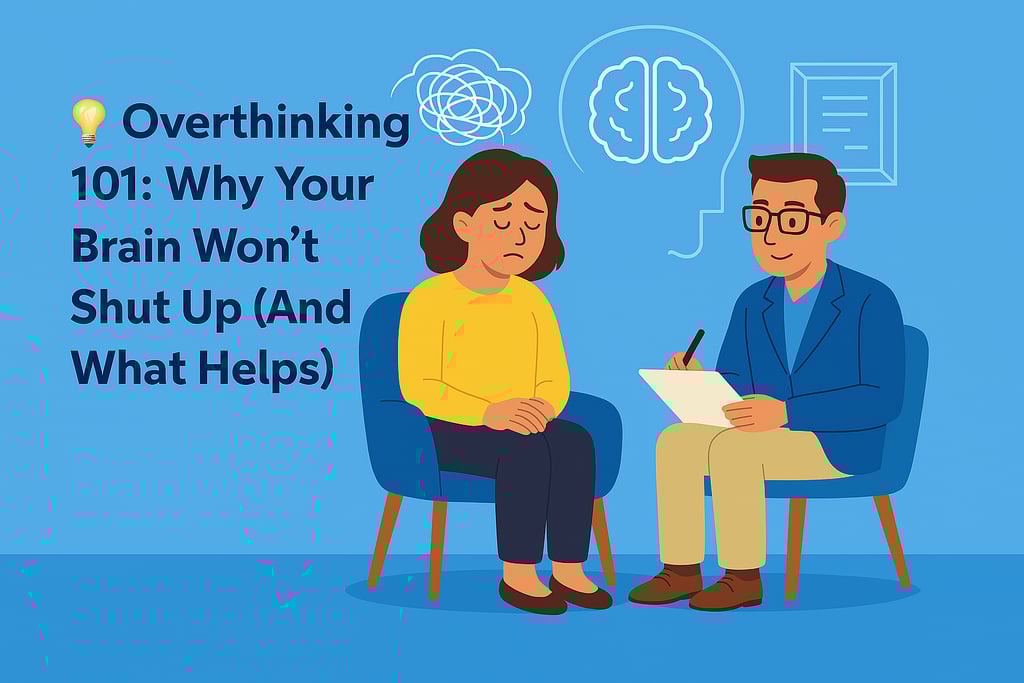
Overthinking 101: Why Your Brain Won’t Shut Up (And What Helps)
You’re lying in bed, tired but wide awake. You replay a conversation from earlier, wondering if you said something wrong. You start planning tomorrow, then spiral into worst-case scenarios. Suddenly it’s 2 a.m., and your brain is doing backflips. Sound familiar? That’s overthinking — and you’re not alone.
4/3/20253 min read
You’re lying in bed, tired but wide awake. You replay a conversation from earlier, wondering if you said something wrong. You start planning tomorrow, then spiral into worst-case scenarios. Suddenly it’s 2 a.m., and your brain is doing backflips. Sound familiar? That’s overthinking — and you’re not alone.
Overthinking is something most of us do. It’s the endless analyzing, the looping thoughts, the mental what-ifs. Sometimes it shows up as worrying about the future. Other times, it’s obsessing over the past. Either way, it’s exhausting. It steals your peace, wastes your energy, and rarely solves anything.
But here’s the thing: overthinking isn’t a personality flaw. It’s a brain trying to protect you — just going about it the wrong way. When your mind keeps spinning, it’s usually trying to prepare for danger, avoid failure, or make sense of uncertainty. The problem is, it often creates more stress instead of less.
So why won’t your brain just chill? Because it hates the unknown. Overthinking gives the illusion of control. If you can just analyze it enough, maybe you’ll avoid pain. Maybe you’ll get it perfect. Maybe you’ll feel certain. But most of life doesn’t work that way. And chasing certainty through overthinking is like trying to mop up the ocean — you just get overwhelmed.
Here’s how to know if you’re stuck in overthinking: You replay conversations in your head. You assume the worst in situations. You struggle to make decisions because you want to “get it right.” You worry about things you can’t control. You second-guess yourself constantly. If any of that sounds like you — welcome to the club. It doesn’t mean you’re broken. It means your brain is doing too much.
The good news? You can train your brain to do less of it. Not perfectly. Not instantly. But over time, you can build habits that interrupt the overthinking spiral and create more peace. Here’s what helps:
1. Name it. When you notice yourself spiraling, say it out loud or in your head: “I’m overthinking.” Naming it creates distance between you and the thought.
2. Get out of your head and into your body. Move. Stretch. Walk. Do something physical to reset your nervous system.
3. Set a worry timer. Give yourself 10 minutes to worry or analyze. When time’s up, shift focus. This keeps it from taking over your day.
4. Practice making “good enough” decisions. Perfectionism feeds overthinking. Done is often better than perfect.
5. Try journaling. Dump your thoughts onto paper. Getting them out of your head can give you clarity.
6. Meditate — even for 2 minutes. You don’t have to be a monk. Just sit, breathe, and notice your thoughts without following them.
7. Ask: Is this useful? Not every thought deserves your attention. Some just need to pass through.
Also, talk about it. Overthinking often feels isolating, but it’s incredibly common. Whether it’s with a friend or a therapist, saying things out loud can break the spell of mental looping.
And remember this: thoughts are not facts. Just because your brain says something doesn’t make it true. The goal isn’t to stop thinking — it’s to stop letting your thoughts run the show.
You’re not weak for overthinking. You’re human. And your brain? It’s doing its best. But you get to guide it. You get to say, “Hey, thanks for trying to protect me, but I’ve got this now.”
So the next time your mind won’t shut up, don’t panic. Recognize what’s happening. Use the tools. And remind yourself: peace isn’t the absence of thought — it’s knowing which ones to listen to.